
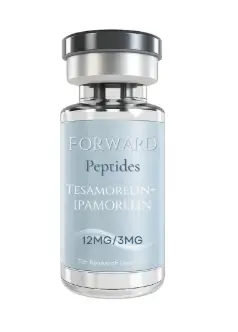
Collection: Metabolic | For Research Use Only

Tesamorelin and Ipamorelin represent two of the most extensively studied compounds in growth hormone secretagogue research. While each has been examined independently across a substantial body of peer-reviewed literature, researchers have increasingly studied them in combination based on their complementary receptor targets and mechanistically distinct pathways to GH stimulation. This post provides a research-focused overview of both compounds individually and the rationale for studying them together.
Growth hormone secretion from the anterior pituitary is regulated primarily by two receptor-mediated pathways. The GHRH receptor (GHRHR) responds to endogenous growth hormone-releasing hormone from the hypothalamus, driving cAMP-dependent GH synthesis and release. The GHS-R1a receptor — the ghrelin receptor — amplifies GH release through a separate calcium-dependent signaling cascade.
Research published in 1999 (PMID: 10372741) established that simultaneous activation of both pathways produces a synergistic GH response that exceeds what either pathway generates independently. Tesamorelin acts on the GHRH receptor; Ipamorelin acts on GHS-R1a. Studying them together engages both axes simultaneously — the mechanistic basis for the dual-pathway stack approach in current GH research.
Tesamorelin is a synthetic analog of endogenous growth hormone-releasing hormone (GHRH), incorporating a trans-3-hexenoic acid modification at the N-terminus that stabilizes the peptide against dipeptidyl peptidase IV degradation — a modification that significantly extends its half-life compared to native GHRH(1-44) while preserving GHRH receptor binding affinity.
Visceral Adipose Tissue Studies
Among the most cited research on tesamorelin is work by Falutz et al. published in The New England Journal of Medicine (PMID: 17636085), which examined tesamorelin 2 mg/day subcutaneously over 26 weeks in a controlled study with over 800 subjects. CT imaging-measured visceral adipose tissue showed approximately 15% reductions versus placebo, with the treatment effect reaching statistical significance (p<0.001). These are among the few body composition outcomes in peptide research documented through objective imaging rather than self-report.
IGF-1 Axis Modulation
Research demonstrates tesamorelin administration increases IGF-1 levels by approximately 50-100 ng/mL from baseline, with elevations detectable within 4-8 weeks and sustained through the study period. Studies document IGF-1 normalization to within physiological reference ranges without the supraphysiological spikes associated with exogenous synthetic GH administration.
Hepatic Fat Research
Research published in The Lancet HIV examined tesamorelin’s effects on hepatic fat fraction, finding reductions of approximately 37% relative to placebo. The proposed mechanism involves both reduced delivery of free fatty acids from visceral depots to the liver via portal circulation and direct GH-mediated effects on hepatic lipid metabolism.
Pulsatile GH Release
A defining characteristic of tesamorelin’s mechanism — shared with other GHRH analogs — is the preservation of natural pulsatile GH secretion patterns. Research by Tannenbaum and Ling (Endocrinology, 1984) established that pulsatile GH delivery produces different downstream tissue responses than continuous GH exposure, particularly regarding hepatic IGF-1 production and receptor sensitivity over time. With tesamorelin, the body’s somatostatin-mediated negative feedback loop also remains intact — a physiological distinction from exogenous GH administration where the regulatory mechanism is bypassed entirely.
Cognitive Research
A study published in Archives of Neurology examined tesamorelin in older adults with mild cognitive impairment. The GHRH-treated group showed improvements in executive function and verbal memory compared to placebo, with the proposed mechanism involving GH/IGF-1 signaling in hippocampal neurons — an area of active investigation given the known age-related decline in GH secretion.
Key research areas for Tesamorelin:
Ipamorelin (Aib-His-D-2-Nal-D-Phe-Lys-NH₂) is a pentapeptide growth hormone secretagogue that acts as a selective agonist at the ghrelin receptor (GHS-R1a). First characterized by Raun et al. in the European Journal of Endocrinology (1998 — PMID: 9349622), Ipamorelin was described as the first selective growth hormone secretagogue — a classification based on its highly targeted GH-releasing effect compared to earlier GHRPs.
What distinguishes Ipamorelin in the research literature is its selectivity profile. Earlier growth hormone releasing peptides — GHRP-2 and GHRP-6 — produced meaningful elevations in cortisol, prolactin, and ACTH alongside GH stimulation, complicating interpretation of GH-specific effects in research settings. Ipamorelin demonstrated minimal impact on these parallel hormonal axes at research doses, making it the preferred GHRP in studies where researchers seek to examine GH secretagogue effects in relative isolation.
Ipamorelin’s short half-life produces discrete GH pulses rather than sustained elevation, a characteristic that aligns with physiological GH pulsatility patterns and has made it a subject of interest in studies examining nocturnal GH secretion and sleep-associated GH dynamics.
Key research areas for Ipamorelin:
The Tesamorelin + Ipamorelin combination studied in research settings engages both the GHRH receptor and GHS-R1a simultaneously — the dual-pathway approach described above. Tesamorelin at the GHRH receptor primes the somatotroph and drives GH synthesis through cAMP-dependent mechanisms, while Ipamorelin at GHS-R1a triggers the GH pulse through the calcium-dependent pathway, producing the supraadditive GH response documented in dual-receptor stimulation research.
The combination is particularly relevant for researchers studying:
Both Tesamorelin and CJC-1295 are GHRH analogs that activate the same GHRH receptor, but they differ in their structural modifications and pharmacokinetic profiles. Tesamorelin’s trans-3-hexenoic acid modification provides stability against enzymatic degradation; CJC-1295’s modifications focus on amino acid substitutions that resist proteolysis. Tesamorelin carries one of the most extensive research evidence bases of any GHRH analog, with a substantial body of controlled study data providing a reference point for researchers studying GH/IGF-1 axis modulation in metabolic contexts.
| Compound | Receptor Target | Key Research Areas |
|---|---|---|
| Tesamorelin | GHRH Receptor | Visceral fat, IGF-1 axis, hepatic lipid metabolism, cognitive function |
| Ipamorelin | GHS-R1a | Selective GH pulses, cortisol sparing, dual-receptor synergy |
| Combined Blend | Dual-pathway | Synergistic GH release, body composition, metabolic regulation |
The Tesamorelin + Ipamorelin blend (12mg/3mg) is available in our Metabolic Collection for research and analytical use only.
Explore Tesamorelin + Ipamorelin →
All products sold by Forward Peptides are intended strictly for research and analytical use only. Not for human or animal consumption. For laboratory use only. This content is provided for informational and research reference purposes and does not constitute medical advice.
Discount Applied Successfully!
Your savings have been added to the cart.