Collection: Build | For Research Use Only
Among the most consistently studied compound pairings in growth hormone secretagogue research, CJC-1295 (without DAC) and Ipamorelin represent two mechanistically distinct peptides that have been examined both individually and in combination. This post covers what peer-reviewed literature has explored regarding each compound’s mechanism, pharmacokinetic profile, and the rationale behind studying them together.
To understand why researchers study this combination, it helps to understand how growth hormone secretion is regulated at the pituitary level. GH release from anterior pituitary somatotrophs is governed by two primary receptor-mediated pathways:
GHRH receptor (GHRHR) — activated by endogenous growth hormone-releasing hormone, this pathway stimulates cAMP-dependent GH synthesis and secretion.
GHS-R1a (ghrelin receptor) — activated by ghrelin and synthetic growth hormone secretagogues, this pathway amplifies GH release through a distinct calcium-dependent signaling mechanism.
Research published in 1999 (PMID: 10372741) demonstrated that simultaneous stimulation of both receptor pathways produces a synergistic GH response — significantly greater than the sum of the individual responses from either pathway alone. This finding forms the mechanistic foundation for studying GHRH analogs and GHRPs in combination, and is the primary rationale behind the CJC-1295 + Ipamorelin pairing in the research literature.
CJC-1295 is a synthetic analog of endogenous growth hormone-releasing hormone (GHRH), incorporating four amino acid substitutions that extend its stability and resistance to proteolytic degradation compared to native GHRH(1-29). The “no DAC” designation distinguishes this form from its longer-acting counterpart — CJC-1295 with DAC (Drug Affinity Complex) — which uses a lysine-maleimidoproprionic acid modification to bind albumin and achieve a half-life of 6-8 days.
CJC-1295 without DAC — also referred to in the literature as Modified GRF(1-29) — retains a half-life of approximately 30 minutes, producing a more pulsatile GH release profile rather than sustained elevation. Research by Tannenbaum and Ling (Endocrinology, 1984) established that pulsatile GH delivery produces different tissue responses than continuous exposure, particularly regarding hepatic IGF-1 production, which has informed researcher preference for the no-DAC formulation when studying oscillatory GH secretion patterns.
A landmark clinical study published in the Journal of Clinical Endocrinology and Metabolism (Teichman et al., 2006) examined CJC-1295 with DAC in healthy adults aged 21-61 across randomized, placebo-controlled, double-blind trials. The study found dose-dependent increases in plasma GH concentrations and IGF-1 levels, with GH concentrations increasing 2-10 times above baseline for up to 6 days following weekly administration and IGF-1 levels rising 1.5-3 fold above baseline for 9-11 days. While this study used the DAC formulation, the underlying GHRH receptor binding mechanism is shared with the no-DAC version.
Key research areas for CJC-1295 (no DAC):
Ipamorelin (Aib-His-D-2-Nal-D-Phe-Lys-NH₂) is a pentapeptide growth hormone secretagogue and selective GHS-R1a agonist developed in the late 1990s. It acts on the ghrelin receptor to stimulate GH release from pituitary somatotrophs through a calcium-dependent pathway that is mechanistically distinct from GHRH receptor signaling.
What distinguishes Ipamorelin from earlier GHRPs in the research literature is its receptor selectivity profile. Raun et al. (European Journal of Endocrinology, 1998 — PMID: 9349622) characterized Ipamorelin as the first selective growth hormone secretagogue, noting that unlike GHRP-2 and GHRP-6 — which triggered meaningful elevations in cortisol, prolactin, and ACTH alongside GH — Ipamorelin demonstrated a targeted GH-releasing effect with minimal impact on these other hormonal axes at research doses.
This selectivity profile has made Ipamorelin a subject of particular interest in studies where researchers seek to examine GH secretagogue effects in relative isolation from broader neuroendocrine activation.
Key research areas for Ipamorelin:
The mechanistic rationale for studying CJC-1295 (no DAC) and Ipamorelin together is grounded in the dual-pathway synergy described above. Because the two compounds act on entirely separate receptor systems — GHRHR and GHS-R1a respectively — their combined administration engages both cAMP and calcium-dependent pathways simultaneously, producing a GH response that research has characterized as supraadditive.
In practical research terms this means CJC-1295 (no DAC) primes the somatotroph via GHRH receptor activation while Ipamorelin simultaneously triggers the GH pulse through the ghrelin receptor — a pairing that mirrors the way endogenous GHRH and ghrelin interact physiologically to regulate GH pulsatility.
The combination has been studied in the context of:
A frequently asked question in the research community concerns the practical difference between CJC-1295 with and without the DAC modification. The core distinction is pharmacokinetic:
CJC-1295 with DAC — albumin binding extends half-life to 6-8 days, producing sustained GH elevation from less frequent administration. Research by Teichman et al. confirmed dose-dependent GH and IGF-1 elevation lasting several days from a single injection in human subjects.
CJC-1295 without DAC (Modified GRF 1-29) — half-life of approximately 30 minutes, producing GH pulses that more closely mimic the physiological oscillatory pattern of endogenous GHRH. Researchers studying GH pulse dynamics or seeking to maintain natural GH pulsatility often prefer this form.
The question of whether GH pulse pattern matters as much as total GH exposure is an active area of investigation, with research by Tannenbaum and Ling establishing that pulsatile delivery produces qualitatively different tissue responses — particularly regarding hepatic IGF-1 production and receptor sensitivity.
| Compound | Receptor Target | Primary Research Areas |
|---|---|---|
| CJC-1295 No DAC | GHRH Receptor (GHRHR) | GH pulsatility, IGF-1 axis, somatotroph regulation |
| Ipamorelin | GHS-R1a (Ghrelin Receptor) | Selective GH secretion, cortisol sparing, GH pulse dynamics |
| Combined Stack | Dual-pathway | Synergistic GH release, body composition, recovery signaling |
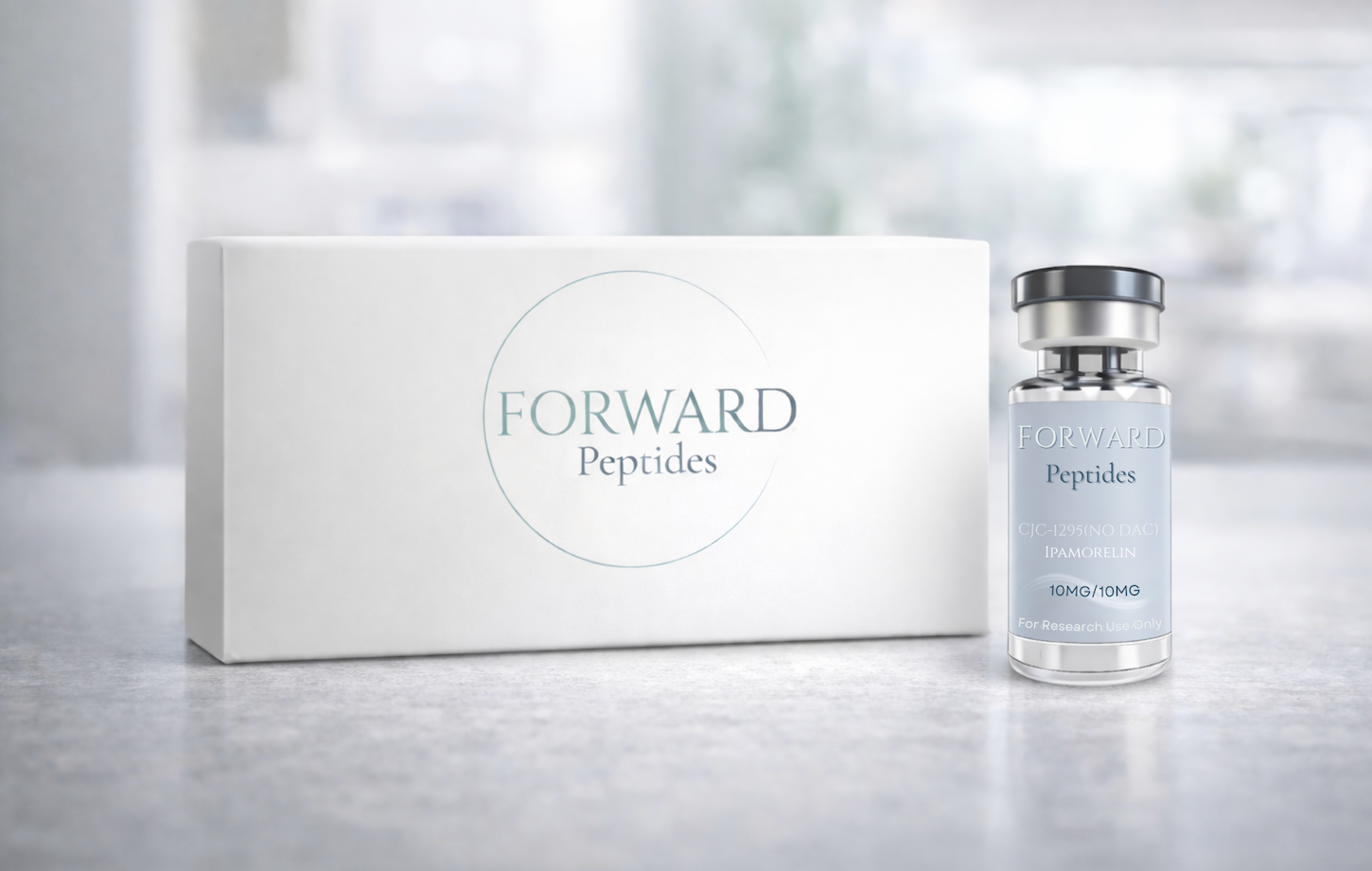
The CJC-1295 + Ipamorelin blend is available in our Build Collection for research and analytical use only.
Explore CJC-1295 + Ipamorelin →
All products sold by Forward Peptides are intended strictly for research and analytical use only. Not for human or animal consumption. For laboratory use only. This content is provided for informational and research reference purposes and does not constitute medical advice.
Discount Applied Successfully!
Your savings have been added to the cart.