

Collection: Longevity | For Research Use Only

Delta Sleep-Inducing Peptide — more commonly referenced in research literature as DSIP — is a nine-amino acid neuropeptide that has been studied across a range of neurological and endocrine contexts since its initial isolation in the 1970s. This post provides a straightforward overview of what peer-reviewed research has explored regarding DSIP, with a focus on the mechanisms and study areas most relevant to current research interest.
DSIP is a nonapeptide with the amino acid sequence Trp-Ala-Gly-Gly-Asp-Ala-Ser-Gly-Glu (WAGGDASGE). It was first isolated in 1974 by Swiss researchers who identified it in the cerebral venous blood of rabbits during slow-wave sleep induction experiments. Subsequent research confirmed its presence in the hypothalamus, limbic system, pituitary gland, and various peripheral tissues — distribution that has led researchers to examine its potential roles in neuroendocrine regulation beyond sleep alone.
DSIP is endogenously produced and co-localizes with multiple hormones and neurotransmitters, a pattern that has informed hypotheses about its broader regulatory functions in the central nervous system.
The primary area of research interest for DSIP has been its relationship to slow-wave sleep and EEG delta wave activity. The peptide’s name derives directly from early findings that its administration was associated with increased delta-wave activity — the brain wave pattern characteristic of deep, restorative sleep stages.
A double-blind study published in the peer-reviewed literature examined DSIP’s effects in chronic insomnia patients across five consecutive nights in a laboratory setting. Polysomnographic measurements indicated higher sleep efficiency and shorter sleep latency in the DSIP group compared to placebo, though researchers noted that the statistically significant effects were described as weak. Subjective tiredness measures also showed some response within the DSIP group.
Research in this area has explored DSIP’s potential interaction with melatonin release modulation and circadian rhythm entrainment pathways, suggesting a mechanism that may operate differently from conventional sleep-regulating compounds.
Beyond sleep architecture, research has examined DSIP in the context of stress-related neurochemistry. A 1992 preclinical study investigated the effects of DSIP administration on substance P concentration — a neuropeptide involved in stress and anxiety regulation — in the hypothalamus. The study reported increased hypothalamic substance P levels following DSIP administration, with researchers noting apparent reductions in classical stress manifestations in the animal model.
Earlier human studies from 1983 — a series of five trials — reported subjects describing improved relaxation and apparently improved tolerance to psychic stress. Researchers noted the possibility that improved stress markers may have been secondary to sleep-related effects, though the relationship between these two mechanisms remains an active area of investigation.
Research has also explored DSIP in connection with hypothalamic-pituitary-adrenal (HPA) axis regulation. Studies have examined its interaction with corticotropin-releasing factor (CRF) pathways, with some findings suggesting DSIP may play a modulatory role in stress-induced HPA activation. This line of research is particularly relevant to investigations of neuroendocrine function and the relationship between sleep disruption and cortisol dysregulation.
One mechanistic area that has received research attention is DSIP’s ability to cross the blood-brain barrier. A 2024 study published in Frontiers in Pharmacology examined DSIP fusion peptides designed to enhance BBB crossing, using a PCPA-induced insomnia mouse model. The research explored neurotransmitter balancing effects and sleep-promoting mechanisms of the DSIP-CBBP fusion construct, contributing to the understanding of how DSIP and its analogs may reach central nervous system targets following peripheral administration.
Earlier research from 1986 noted that direct intracerebroventricular injection of DSIP in rats did not consistently increase sleep, which the researchers attributed to rapid metabolic degradation — a finding that has informed subsequent work on DSIP analogs and delivery optimization.
The identification of DSIP analogs with differential biological activity has been a notable area of investigation. Research involving direct injection of DSIP and several structural analogs into the cerebral ventricle of rats found that while native DSIP showed inconsistent effects in that model, certain analogs demonstrated sleep-inducing properties while others produced arousal — suggesting that structural modification of the peptide sequence may significantly alter its receptor binding profile and downstream effects. This finding has implications for understanding DSIP’s mechanism of action at the molecular level.
It is worth noting that DSIP research was most active during the 1970s through early 1990s, with a subsequent decline in published output. The reasons for this shift are varied and include challenges related to the peptide’s short half-life, variability in study designs, and relatively small sample sizes in human trials. More recent research has returned to DSIP with improved methodological approaches, particularly in the context of fusion peptides and BBB penetration studies.
The foundational review by Graf and Kastin (Neuroscience and Biobehavioral Reviews, 1984) remains a primary reference for the early mechanistic literature and provides a comprehensive overview of DSIP’s identified properties as understood at that time.
DSIP has been studied in connection with the following research contexts:
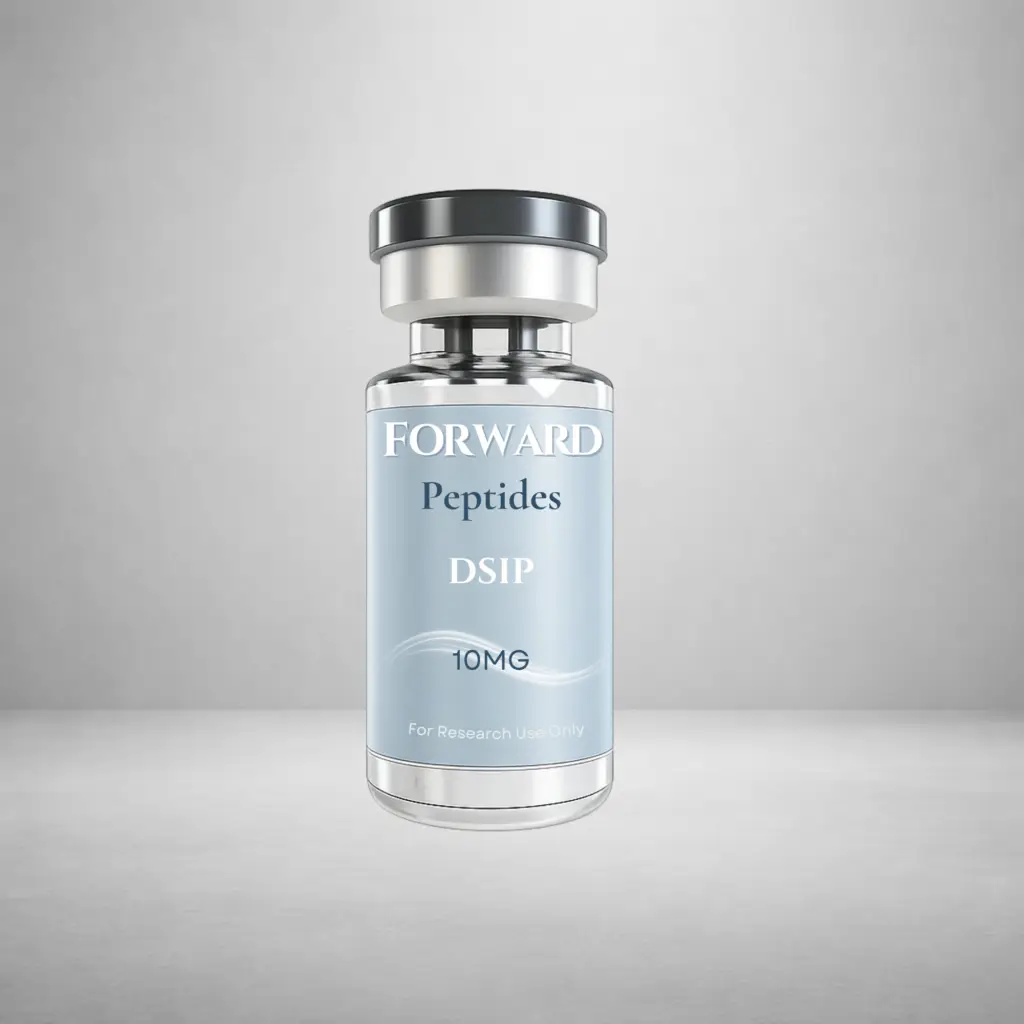
DSIP is available in our Longevity Collection for research and analytical use only.
All products sold by Forward Peptides are intended strictly for research and analytical use only. Not for human or animal consumption. For laboratory use only. This content is provided for informational and research reference purposes and does not constitute medical advice.
Discount Applied Successfully!
Your savings have been added to the cart.